Mc Midnight Commander For Mac
. 3915cleanup: (24 commits) Update po/.po files. Src/filemanager/panelize.c: fix coding style. Sync with gnulib 8ebb74fde62e5017bf838c69db22c4.
Sync with gnulib 1ff0e9684bb83a8277ffe22ac125ce7e90f6702b. Sync with gnulib e96dcbcbc5142bd04c6c2e9e4595d9bea910fb3b. Sync with gnulib 23671eec22f5221a2dff50942f24c41bcf9caeaf. Sync with gnulib 8ae091f7c8cd35cc7dff82c544d04da6fd095e11. Sync with gnulib 4d4877e6c2123c4862c321f3eab28a55bf886216. Sync with gnulib cbc85bb67fc6b835efc9e91cd0482f.
Sync with gnulib be9e66b37c948df517ee905b4a969c. (makesymlink): rename variable. (domovedirdir): rename variables.
(copydirdir): rename variables. Misc/syntax/Syntax.in: simplify regex for PO and CUDA syntaxes. Misc/syntax/Syntax.in: fix regex for Meson syntax.
Dirlist: fix memory leak when list is free'd. Sync with gnulib f7a6286e04209da1bc7b1820002b6a5c32638369. Sync with gnulib d1327df1f1c9bae800c8d1c4712afb. Sync with gnulib fa3e2ad20d10d648cc74a5d320ce531a80ff7b1f. Sync with gnulib 74c29c68bba3fe7c2f02eb3fc9f7ef196cec1bc6.
Contents - Introduction Dependencies Features Mini-documentation Where to get more information Reporting problems Introduction - GNU Midnight Commander (also referred to as MC) is a user shell with text-mode full-screen interface. It can be run on the OS console, in xterm and other terminal emulators. GNU Midnight Commander allows you to manage files while making most of you screen and giving you a clear representation of the filesystem, yet it's simple enough to be run over a telnet or ssh session. GNU Midnight Commander is released under the GNU General Public License version 3 or any later version.
A copy of the file is included with this distribution package. Dependencies - Please read the file INSTALL for installation instructions and full list of dependencies. Features - GNU Midnight Commander was conceived as a free clone of John Socha's Norton Commander (TM). It also takes the best from more recent software with similar interfaces.
GNU Midnight Commander comes with mouse support on xterm and optionally on the Linux console. Some features are specific to the POSIX environment MC runs on, some are familiar to the users of similar software for other operating systems. The features include:. Built in Virtual File System: manipulate remote file systems through the FTP and SMB protocols or over secure shell, browse contents of tar, ar, rpm, zip, cpio, lha and rar archives just like local files. Almost all operations work with the virtual file system, enabling you to do complex tasks, like viewing files in archives on an FTP server. Mouse support on most terminal emulators for X Window System as well as on the Linux console.
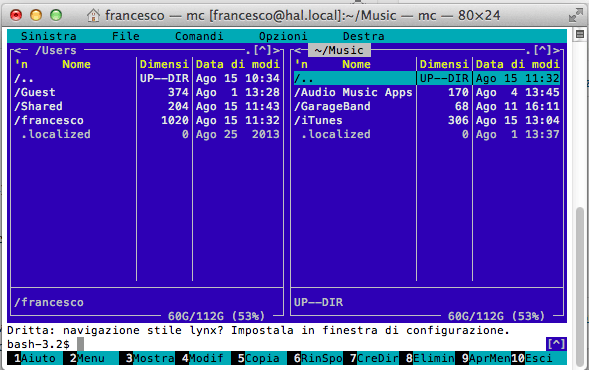
Learn Keys: GNU Midnight Commander may be configured at run time to support any kind of input keys for a given terminal, making its operation possible even on most weird terminals. Text and hex editors are available for you to use (hex editor is a part of the viewer). Hotlist allows you to keep a list of common visited locations, including remote sites and directories inside archives. Command completion: By pressing Alt-Tab in any place where a filename or an executable are expected, GNU Midnight Commander will complete the name for you. If you press Alt-Tab for the second time, you get a list box with all possible completions. Subshell support: Run your commands by a real shell interpreter.
GNU Midnight Commander interacts with bash, tcsh and zsh to provide you with all of the facilities available in your preferred shell. Find file command can search for the file contents.
Mc Midnight Commander For Mac Torrent
Background operations allow you to copy or move files from any virtual file system while you do other tasks (i.e., you can do background FTP copies). FTP proxy is supported.
Linux file recovery: If you are using Linux, you can recover deleted files from an ext2 or ext3 partition with the undelete file system. This is a low level file recovery function that can recover files deleted by any program on Linux. External panelization: You can run any arbitrary external command and GNU Midnight Commander will display the output generated as a file listing that can be manipulated as a regular directory. Emacs-like key bindings are used in all widgets.
Context dependent actions (open, view, edit) are available. The built-in file viewer, together with the context dependent actions is used to format man pages on the fly, coloring mail messages and more.
The built-in editor supports syntax highlighting and external actions, such as spell checking and formatting. Mini-documentation - These are hints for the text mode edition:. Use the F-Keys for invoking the commands in the function key bar. If your terminal doesn't support F-keys, you can use the sequence to invoke the corresponding F-digit key. Tab changes the current panel.
All input lines have emacs-like key-bindings (command history is accessed through the M-p and M-n keys). The panels accept C-n, C-p for browsing the panel (like in Emacs). M-Enter copies the currently selected file name to the input line. M-Tab completes the current word (or tries to).
The Virtual File System is a cute addition to the project, you may browse in tar and compressed tar files as well as browsing remote machines with the fish file system. Please read the manual page. You can access the whole documentation online with the F1 key, although it's not as nice as the groff printed manual page:-) Where to get more information - There is a webpage for GNU Midnight Commander at This page also has current information about mailing lists and some useful advices how to report bugs.
You can download the latest version of GNU Midnight Commander from Reporting problems - You can report bug on our site, please read Also you can use mc mailing lists to discuss problems. There are two mailing lists, mc@gnome.org and mc-devel@gnome.org. Use mc-devel@gnome.org if you are prepared for a more technical discussion with the developers of the package, otherwise use mc@gnome.org.
Please don't sent HTML e-mail to either of those mailing lists. Include the output of 'mc -version', the operating system and the distribution (if applicable) you are using, the compiler and the configure flags used to compile the program (if you know them).
If the program crashed and produced a core dump, please provide a stack trace of the program. You can do this by running gdb like this: gdb mc core (gdb) where.
I’m considering to use to review some dozens of source files in php/css. However currently on my Debian Lenny I have configured to be the default editor in the system.
The way I’ve setupped my vim to be the default editor is not really canonical, I mean I did it through $EDITOR variable in my /root/.bashrc and my /.bashrc file. In other words I have: export VISUAL='vim' export EDITOR='vim' in my.bashrc files.
Though the correct way to do that is actually either by: hipo@noah:# update-alternatives -config editor or through by linking /etc/alternatives/editor to your vim for instance: hipo@noah:# rm -f /etc/alternatives/editor hipo@noah:# ln -sf /usr/bin/vim /etc/alternatives/editor As a result of my non-canonical ways to do things on the Debian as whenever I tried opening files with midnight commander (mc), files ended opening with vim. I have to note that really sux a lot and therefore I hurried up to change mc’s behaviour back to normal. Here is how: While in mc press F9 and go to the Options menu, then navigate to Configuration Now tick on the text reading: use internal edIt afterwards it might be also a good idea to select Save Setup from the Options in order to save changed settings for future use.